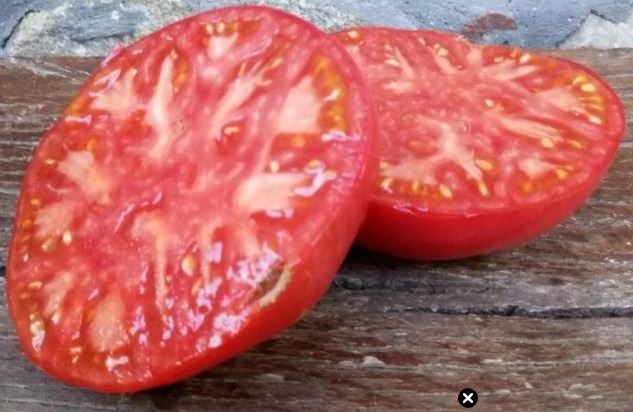
A tomato born in Cantabria and for Torrelavega: large, fleshy, beefsteak-type, green on the outside and red on the inside, with the colors of the city's flag. Sweetness and acidity in perfect balance, and a fragrance that awakens at full maturity.
History and origin
Señorío de la Vega is a recently created variety originating in Cantabria. It was developed by Guy Ferrier within the Simientes Infinitas Association, based on the daily work of conserving and reproducing the collection of heirloom varieties held by the association.
It is the result of a cross between two excellent heirloom tomatoes: English Rose, with red fruit, and Verde de las Landas, with green fruit. From this union comes a tomato that brings together the best of both: large size and beefsteak-type flesh, a green skin inherited from the green parent, and red pulp revealed when cut. After 10 generations, it is stabilized and produces uniform fruit
This contrast of colors is no coincidence. The green exterior and red interior represent the colors of the flag of the city of Torrelavega, and the variety's name evokes the historic Señorío de la Vega, linked to the origins of the town. The association has donated the variety to the Torrelavega City Council, so that the city now has a tomato of its own.
Key characteristics
-
Recent Cantabrian creation: obtained by Guy Ferrier at Simientes Infinitas
-
Heirloom parents: English Rose (red) × Verde de las Landas (green)
-
Torrelavega colors: green on the outside and red on the inside, like the city's flag
-
Donated to the Torrelavega City Council: a tomato with a sense of place
-
Large beefsteak-type fruit: 200-350 g, with very pleasant flesh and texture
-
Balanced flavor: very well-balanced sweetness and acidity; fragrant at full maturity
Cultural importance
Señorío de la Vega demonstrates that heirloom collections are not closed archives, but the raw material for varieties that do not yet exist. Without English Rose and Verde de las Landas, conserved and reproduced year after year, this tomato would not have been possible. Safeguarding diversity also means keeping the possibility of creation open.
It is also a variety with a sense of place. It was born in Cantabria, bears the colors of Torrelavega and a name linked to its history, and has been donated to the city as a common good. This gesture makes it a shared symbol, which can be grown in urban gardens, featured in tastings and events, and passed from hand to hand as open-pollinated seed, just like the traditional varieties from which it comes.
Technical descriptors
Plant descriptors
| Characteristic |
Evaluation |
| Growth type |
Indeterminate |
| Growth habit |
Bushy, with abundant foliage |
| Plant height |
Tall (150-200 cm) |
| Foliage density |
High |
| Leaf type |
Regular (normal leaf) |
| Leaf color |
Green |
|
|
|
|
Fruit descriptors
| Characteristic |
Evaluation |
| Fruit type |
Beefsteak (beefsteak) |
| Fruit weight |
Large (200-350 g) |
| Mature fruit color (exterior) |
Speckled green |
| Pulp color |
Red and green hues |
| Pulp texture |
Fleshy, beefsteak-type, very pleasant in the mouth |
| Sweetness / acidity balance |
Very well balanced |
| Aroma |
Fragrant at full maturity |
| Organoleptic profile |
Excellent flavor |
| Fruit shape |
Flattened, with shoulders |
| Number of locules |
Few |
| Skin thickness |
Thin |
| Number of seeds |
Not very abundant |
Agronomic characteristics
| Characteristic |
Evaluation |
| Cycle |
Late (85-90 days) |
| Productivity |
Average |
| Climate adaptation |
Humid Atlantic climate of the Cantabrian cornice |
| Need for staking |
Essential (height of 1.5-2 m and large fruit) |
| Yield per plant |
Approx. 5-6 kg |
| Post-harvest storage |
Preferably immediate consumption |
Resistances and tolerances
| Characteristic |
Evaluation |
| Fungal diseases (overall) |
Tolerant (observation in cultivation in Cantabria) |
| Specific pathogens (mildew, alternaria, septoria, powdery mildew) |
Pending specific evaluation |
| Fusarium and Verticillium |
No data |
| Viral diseases |
No data |
| Fruit disorders (cracking, blossom end rot) |
Susceptible like other varieties |
Note: resistance to fungi is based on observations of the variety in cultivation under the humid conditions of the Cantabrian cornice where it was selected. These are not formally characterized resistance genes. As it is a recently created variety, the descriptors marked as pending will be completed with data from upcoming growing seasons.
Cultivation tips
-
Sow early: as it is a late variety, it is advisable to sow early to ensure harvest before autumn
-
Sturdy staking: tall and bushy plant with fruit weighing up to 350 g
-
Regular irrigation: consistent watering prevents cracking and blossom end rot in large fruit
-
Harvest at full maturity: this is when it develops its fragrance; as it is green on the outside, it is best to rely on touch, when the fruit gives slightly under pressure
Recommended uses
-
Salad: its ideal use, where its balanced flavor and fragrance shine
-
Sliced, raw: the green and red contrast when cut can be appreciated in all its splendor
-
Tastings and variety events: a variety with its own history and a great presence on the table
-
Events and promotion in Torrelavega: a product with the colors and name of the city
-
Urban and school gardens: an open-pollinated variety to grow and share seeds
Terminological precision: Señorío de la Vega is not an heirloom variety in the strict sense, but a modern open-pollinated variety obtained from two heirloom tomatoes. It still lacks the generational transmission that defines traditional varieties, although it originates from them and shares their vocation as a common good.
Origin: recently created variety originating in Cantabria, developed by Guy Ferrier at the Simientes Infinitas Association from a cross between English Rose (red tomato) and Verde de las Landas (green tomato), two heirloom varieties. Its colors represent the flag of Torrelavega and it has been donated to the city council.
Variety conserved and reproduced by the Simientes Infinitas Association, which preserves a collection of 1,700 heirloom tomato varieties to prevent genetic erosion.