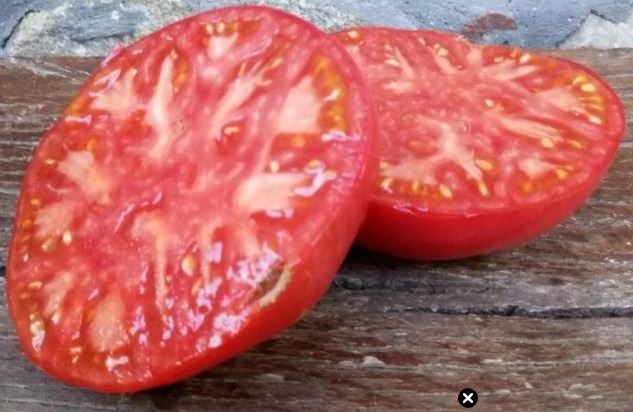
Characterization Descriptors of the "Pink Berkeley Tie Dye" Heirloom Tomato
History and Origin of the Variety
Historical Origin
This exceptional variety was obtained by Bradley (Brad) Gates at Wild Boar Farms in northern California (United States). It is a stabilized accidental cross of unknown parentage that arose spontaneously in a field of his Berkeley Tie-Dye variety, which Gates selected and stabilized over several generations. Some European sources describe it as a spontaneous mutation of Berkeley Tie-Dye, a variety that in turn is attributed to a cross between "Cherokee Purple" and "Green Zebra". It first appeared in the 2008 Seed Savers Exchange Annual, offered by Gary W. Maness of North Carolina and Al Anderson of Ohio, who received the seeds directly from Brad Gates.
Variety Fun Facts
-
The breeder's favorite: Brad Gates considers it his favorite variety, and it is the best-selling at Wild Boar Farms, both as plants and as seeds.
-
Award-winning variety: It has won numerous competitions, including an award at the Petaluma (California) Heirloom Expo.
-
Success in tastings: In tastings held at farmers' markets, it has repeatedly been preferred over "Cherokee Purple", one of the benchmark tomatoes for its flavor.
-
Fog-tolerant: According to its breeder, it tolerates the cool fogs of the San Francisco Bay Area and is recommended for marginal tomato-growing regions.
-
The breeder's legacy: Brad Gates, known in the Bay Area as "the tomato guy", has developed several dozen varieties, with a preference for bicolor and striped varieties.
-
The "Tie Dye" family: It is part of a series of striped tomatoes from Wild Boar Farms, along with Berkeley Tie-Dye (green) and other striking color selections.
Cultural Significance
This variety is an example of a "modern heirloom": a recent, open-pollinated, and royalty-free variety selected by a farmer from the natural variation of their own crops. It represents the continuation of the farmer-led selection work that gave rise to traditional varieties, and its conservation helps preserve the genetic diversity that is continually generated by horticulturists themselves.
1. Plant Descriptors
| Characteristic |
Evaluation for "Pink Berkeley Tie Dye" |
| Growth type |
Indeterminate (compact) |
| Growth habit |
Upright |
| Plant height |
Medium-tall (150-200 cm) |
| Plant vigor |
Strong |
| Young stem color |
Green |
| Stem pubescence |
Present |
| Hair density |
Medium |
| Leaf type |
Regular (not potato-type) |
| Leaf color |
Green |
| Leaflet shape |
Regular (normal leaf) |
| Leaflet margin |
Serrated |
| Leaf pubescence |
Present |
3. Fruit Descriptors
| Characteristic |
Evaluation for "Pink Berkeley Tie Dye" |
| Fruit shape |
Oblate - flattened beefsteak, some globose |
| Fruit weight |
Medium to large (150-400 g; usually 230-340 g) |
| Fruit diameter |
Large (approx. 7-10 cm) |
| Immature fruit color |
Green with darker stripes |
| Mature fruit color |
Maroon/Port wine with metallic green stripes |
| Color intensity |
Very intense |
| Color uniformity |
Distinctive stripes, more pronounced on the upper part |
| Presence of green shoulders |
Present (dark green) |
| Shoulder shape |
Rounded |
| Surface smoothness |
Slightly ribbed in the upper area |
| Presence of ribs |
Slight |
| Fruit shine |
Shiny, with a metallic reflection |
| Calyx scar |
No documented data |
| Pistil scar |
No documented data |
| Number of locules |
No documented data |
| Locule distribution |
No documented data |
| Wall thickness |
Thick (dense and fleshy pulp) |
| Pulp firmness |
Firm |
| Pulp color |
Dark brick red, with dark green gel |
| Juiciness |
Moderate (very fleshy pulp) |
| Seed count |
No documented data |
6. Agronomic Characteristics
| Characteristic |
Evaluation for "Pink Berkeley Tie Dye" |
| Days to flowering |
No documented data |
| Days to harvest |
Early to medium (65-80 days after transplanting) |
| Yield per plant |
High |
| Number of fruits per plant |
No documented data |
| Harvest concentration |
Staggered, from mid-season through the frosts |
| Heat tolerance |
Tolerant |
| Cold tolerance |
Moderately tolerant (adapted to cool and foggy climates) |
| Adaptation to low light |
Good (recommended for marginal climates) |
7. Resistances and Tolerances
| Pathogen/Pest |
Evaluation for "Pink Berkeley Tie Dye" |
| Alternaria (Alternaria solani) |
No documented data |
| Fusarium (Fusarium oxysporum) |
Resistant (according to some suppliers) |
| Verticillium (Verticillium dahliae) |
No documented data |
| Mildew (Phytophthora infestans) |
No documented data |
| Bacterial wilt (Ralstonia solanacearum) |
No documented data |
| Bacterial speck (Pseudomonas syringae) |
No documented data |
| Tomato mosaic virus (ToMV) |
Susceptible (no known resistances) |
| Tomato yellow leaf curl virus (TYLCV) |
Susceptible (no known resistances) |
| Whitefly (Bemisia tabaci) |
Susceptible |
| Thrips (Thrips tabaci) |
Susceptible |
| Aphids |
Susceptible |
Special Characteristics of the "Pink Berkeley Tie Dye" Variety
Outstanding Attributes:
-
Exceptional flavor: Sweet, rich, and intense, typical of the best dark tomatoes; repeatedly preferred over Cherokee Purple in tastings.
-
Unique appearance: Maroon or Port wine-colored fruits with distinctive metallic green stripes and dark green shoulders.
-
Spectacular pulp: Dark brick-red flesh, dense and fleshy, with dark green gel.
-
Considerable size: Beefsteak-type fruits weighing 150-400 grams, ideal for slicing.
-
Early maturity: One of the earliest striped beefsteak varieties, with harvest at 65-80 days.
-
Generous productivity: High and regular production, even on compact plants.
-
Climate adaptability: Performs well in cool, humid, or foggy climates, as well as in warm climates.
-
Good overall tolerance: Described as having good disease tolerance and resistance to fruit cracking.
Limitations:
-
Thin skin: The fruits can be delicate and have a short shelf life after harvest, according to some growers.
-
Size variability: Fruit weight varies considerably depending on the climate and management.
-
Flavor variability: Some growers find it more acidic than usual for dark tomatoes.
-
Need for support: Requires sturdy staking from the beginning of the season.
-
Irrigation sensitivity: Requires regular irrigation to maintain fruit quality.
-
Limited sanitary data: Documented trials against mildew and other diseases common in humid climates are lacking.
Recommended Uses:
-
Fresh consumption: Excellent for salads, carpaccio, and sandwiches; considered an ideal tomato for sandwiches.
-
Slicing tomato: Perfect for thick slices that showcase the contrast between the striped skin and dark pulp.
-
Haute cuisine: Highly valued by restaurants and chefs for its flavor and presentation.
-
Visual presentation: Ideal for platters and salads alongside green, yellow, and bicolor varieties.
-
Tastings and tastings: A highly appreciated variety in tastings for its flavor and appearance.
-
Seed conservation: A stable open-pollinated variety, suitable for saving seeds and preserving genetic diversity.
Data based on sources specializing in heirloom varieties, including Tatiana's TOMATObase, specialized seed catalogs, the University of California Master Gardeners variety guide, and interviews with Brad Gates (Wild Boar Farms). Yield, resistance, and conservation data come from third parties and may vary under the growing conditions in Cantabria.