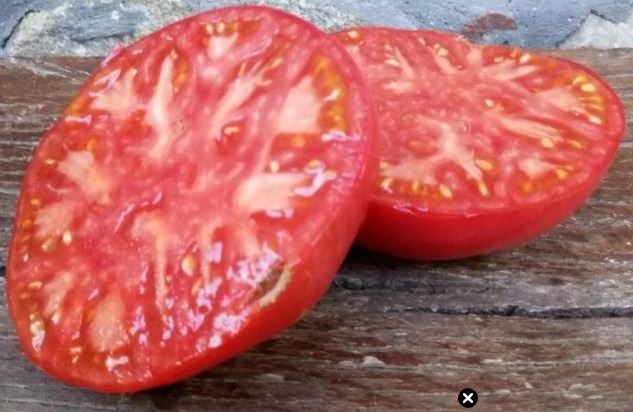
Characterization Descriptors of the "Basajaún" Heirloom Tomato
Simientes Infinitas Association
We safeguard, preserve, and reproduce a collection of 1,700 heirloom tomato varieties for the public. We work to prevent genetic erosion.
History and Origin of the Variety
Historical Origin
Basajaún is an extraordinary heirloom variety originating from the Spanish Basque Country, created and stabilized by the renowned collector and preservationist Ion Couso Ureta. This variety represents the result of nearly three decades of meticulous breeding and selection work, which began approximately 30 years ago with local Basque varieties and traditional family varieties that Ion Couso had cultivated for many years in his native region.
The history of Basajaún is fascinating: it originated from the cross between a family variety designated BAs23-92 (as these traditional varieties lacked specific names) and the result of an accidental cross between two additional varieties that Ion was growing at the time. This double-crossing process initially produced a variety that was named "Iñigo" in honor of a farmer who had provided the BAs23-92 variety. However, the name was later changed to "Basajaún" to avoid confusion with the original parent variety.
Variety Curiosities
-
Mythological name: "Basajaún" means "Lord of the Forest" in Basque, referring to the benevolent giant of Basque mythology
-
Modern creation: Developed by Ion Couso Ureta, one of the most respected preservationists in the Basque Country
-
Decades of work: The result of nearly 30 years of careful selection and breeding
-
Giant fruits: Capable of producing tomatoes weighing over 1 kilogram (recorded record: 1,650 g)
-
Basque cultural heritage: Incorporates genetics from traditional family varieties of the Basque Country
-
Naming process: Originally called "Iñigo," renamed to honor Basque mythology
-
Exceptional late variety: Renowned for its late but spectacular ripening
Cultural Significance
Basajaún transcends its horticultural value to become a symbol of Basque cultural preservation. The name honors the mythological Basajaún, the protective giant of the forests in Basque tradition, who according to legends taught humans the arts of agriculture, metallurgy, and construction. This variety represents the continuity of that tradition of agricultural knowledge, with Ion Couso Ureta acting as a modern "Basajaún," passing down ancestral wisdom through the preservation and breeding of traditional varieties. Its development demonstrates how modern innovation can honor and preserve the genetic and cultural heritage of a region.
1. PLANT DESCRIPTORS
| Characteristic |
Evaluation for "Basajaún" |
| Growth type |
Indeterminate |
| Growth habit |
Erect and vigorous |
| Plant height |
Very tall (>180 cm) |
| Plant vigor |
Exceptional |
| Young stem color |
Green |
| Stem pubescence |
Present |
| Hair density |
Medium |
| Leaf type |
Regular (not potato-type) |
| Leaf color |
Dark green |
| Leaflet shape |
Regular (normal leaf) |
| Leaflet margin |
Serrated |
| Leaf pubescence |
Present |
2. FRUIT DESCRIPTORS
| Characteristic |
Evaluation for "Basajaún" |
| Fruit shape |
Oblate - flattened and rounded |
| Fruit weight |
Giant (500–1,650 g) |
| Fruit diameter |
Giant (>15 cm) |
| Immature fruit color |
Green |
| Mature fruit color |
Intense red |
| Color intensity |
Very intense |
| Color uniformity |
Uniform |
| Presence of green shoulders |
Absent |
| Shoulder shape |
Smoothly rounded |
| Surface smoothness |
Smooth |
| Presence of ribs |
Slightly ribbed |
| Fruit shine |
Shiny |
| Calyx scar |
Large |
| Pistil scar |
Star-shaped |
| Number of locules |
6–10 |
| Locule distribution |
Regular |
| Wall thickness |
Very thick (>8 mm) |
| Pulp firmness |
Firm and very fleshy |
| Pulp color |
Intense red |
| Juiciness |
Juicy |
| Number of seeds |
Few (<40) |
3. AGRONOMIC CHARACTERISTICS
| Characteristic |
Evaluation for "Basajaún" |
| Days to flowering |
Late (80–90) |
| Days to harvest |
Very late (90–100 days from transplanting) |
| Yield per plant |
Exceptional (8–12 kg) |
| Number of fruits per plant |
Low to medium (5–12) |
| Harvest concentration |
Staggered (end of season) |
| Heat tolerance |
Good |
| Cold tolerance |
Moderate |
| Adaptation to low light |
Regular |
| Recommended spacing |
80–100 cm between plants |
4. RESISTANCES AND TOLERANCES
| Pathogen/Pest |
Evaluation for "Basajaún" |
| Alternaria (Alternaria solani) |
Moderately resistant |
| Fusarium (Fusarium oxysporum) |
Moderately resistant |
| Verticillium (Verticillium dahliae) |
Moderately resistant |
| Late blight (Phytophthora infestans) |
Susceptible |
| Bacterial wilt (Ralstonia solanacearum) |
Susceptible |
| Bacterial speck (Pseudomonas syringae) |
Susceptible |
| Tomato mosaic virus (ToMV) |
Susceptible |
| Tomato yellow leaf curl virus (TYLCV) |
Susceptible |
| Whitefly (Bemisia tabaci) |
Susceptible |
| Thrips (Thrips tabaci) |
Susceptible |
| Aphids |
Susceptible |
| Cracking |
Resistant |
SPECIAL CHARACTERISTICS OF THE "BASAJAÚN" VARIETY
Outstanding Attributes
-
Record-breaking fruit size: capable of producing tomatoes weighing over 1.5 kilograms, among the largest documented
-
Exceptionally sweet flavor: excellent and sweet flavor that perfectly balances its giant size
-
Artisanal creation: developed by Ion Couso Ureta through three decades of dedicated work
-
Authentic Basque heritage: incorporates genetics from traditional family varieties of the Basque Country
-
Extraordinary productivity: exceptional yields despite the giant size of the fruits
-
Unique cultural value: named in honor of the Basque mythology of Basajaún, the protective lord of the forests
-
Masterpiece of breeding: represents the culmination of the art of traditional seed selection
Limitations
-
Very late season: requires a very long growing season (90–100 days) for full development
-
Massive structural support: needs exceptionally robust support systems to hold giant fruits
-
Specialized management: requires advanced experience in growing giant varieties
-
Mandatory wide spacing: needs generous spacing due to the exceptional size of the plants and fruits
-
Very limited availability: extremely rare variety created by a single preservationist
-
Climate vulnerability: susceptible to adverse weather conditions due to its late cycle
Recommended Uses
-
Basque cultural preservation: essential for keeping this work of modern Basque breeding alive
-
Collecting: unique variety for specialized collections
-
Breeding research: valuable for studies on giant fruit development and selection techniques
-
Signature cuisine: appreciated for its size, flavor, and history
-
Preservation education: excellent tool for explaining the work of preservationists
-
Demonstration gardens: suitable for showcasing the diversity of heirloom tomatoes
-
Special fresh consumption: excellent for occasions where size and flavor take center stage
-
Artisanal preserves: suitable for quality preserves and sauces
-
Genetic heritage: relevant for preserving the legacy of Ion Couso Ureta's work
Data based on documentation by Ion Couso Ureta, records from Jardins de Tomates (France), information from Cultive ta rue, testimonials from collectors specializing in Basque varieties, and cultural references to the mythology of Basajaún in the Basque Country.