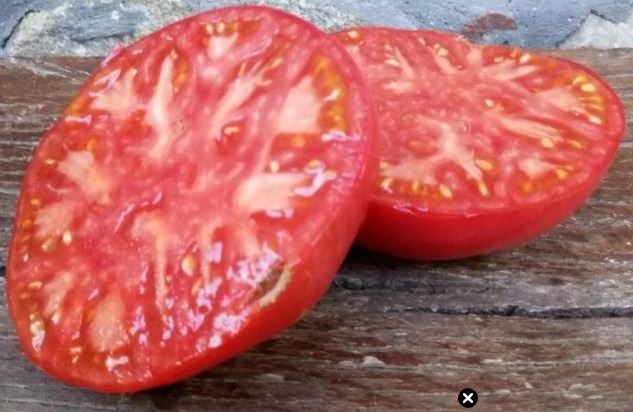
Characterization Descriptors of the "Aker's West Virginia" Heirloom Tomato
History and Origin of the Variety
Historical Origin
This heirloom family variety originated in West Virginia, United States. It was preserved by Carl Aker of Pennsylvania, an enthusiastic tomato specialist who, since 1993, has dedicated himself to rehabilitating heirloom tomato varieties and sharing his findings with Craig LeHoullier. In 1996, Carl Aker sent Craig LeHoullier some seeds labeled simply as "West Virginia". Craig added the designation "Aker's" to distinguish it from other varieties with the same geographic name.
Variety Fun Facts
-
Historical designation: The original name was simply "West Virginia", and it was Craig LeHoullier who added "Aker's" in honor of the variety's preserver
-
Catalog appearance: It first appeared in the 1997 Seed Savers Exchange Annual
-
Literary recognition: It is one of the 100 heirloom varieties cited in the book "100 Heirloom Tomatoes for the American Garden" by Dr. Carolyn Male
-
Genetic heritage: It represents a valuable genetic heritage of traditional American family varieties
-
Unique feature: The fruits do not develop green shoulders like other red tomatoes during ripening
-
Expert favorite: Craig LeHoullier considers it one of his best red varieties for consistency and flavor
Cultural Significance
This variety is a living testament to the American family horticultural tradition and represents the importance of conserving traditional local varieties. Its preservation by Carl Aker and subsequent popularization by Craig LeHoullier exemplifies the value of seed exchange among dedicated collectors.
1. Plant Descriptors
| Characteristic |
Evaluation for "Aker's West Virginia" |
| Growth type |
Indeterminate |
| Growth habit |
Compact erect |
| Plant height |
Medium-tall (120-150 cm) |
| Plant vigor |
Strong |
| Young stem color |
Green |
| Stem pubescence |
Present |
| Hair density |
Medium |
| Leaf type |
Regular (not potato-type) |
| Leaf color |
Green |
| Leaflet shape |
Regular (normal leaf) |
| Leaflet margin |
Serrated |
| Leaf pubescence |
Present |
2. Fruit Descriptors
| Characteristic |
Evaluation for "Aker's West Virginia" |
| Fruit shape |
Round to oblate - Slightly flattened |
| Fruit weight |
Large (280-500 g) |
| Fruit diameter |
Large (8-10 cm) |
| Immature fruit color |
Green |
| Mature fruit color |
Scarlet red without green shoulders |
| Color intensity |
Intense |
| Color uniformity |
Uniform |
| Presence of green shoulders |
Absent |
| Shoulder shape |
Normal |
| Surface smoothness |
Mostly smooth |
| Presence of ribs |
Slight wrinkles |
| Fruit shine |
Shiny |
| Calyx scar |
Large with corky depression |
| Pistil scar |
Linear |
| Number of locules |
4-6 |
| Locule distribution |
Regular |
| Wall thickness |
Thick (>6 mm) |
| Pulp firmness |
Firm |
| Pulp color |
Red |
| Juiciness |
Very juicy |
| Seed count |
Moderate (50-100) |
3. Agronomic Characteristics
| Characteristic |
Evaluation for "Aker's West Virginia" |
| Days to flowering |
Medium (65-75) |
| Days to harvest |
Medium-late (85-90 days from transplanting) |
| Yield per plant |
High (4-7 kg) |
| Number of fruits per plant |
Medium (15-25) |
| Harvest concentration |
Staggered |
| Heat tolerance |
Tolerant |
| Cold tolerance |
Moderately tolerant |
| Adaptation to low light |
Regular |
4. Resistances and Tolerances
| Pathogen/Pest |
Evaluation for "Aker's West Virginia" |
| Alternaria (Alternaria solani) |
Moderately resistant |
| Fusarium (Fusarium oxysporum) |
Moderately resistant |
| Verticillium (Verticillium dahliae) |
Moderately resistant |
| Late blight (Phytophthora infestans) |
Susceptible |
| Bacterial wilt (Ralstonia solanacearum) |
Susceptible |
| Bacterial speck (Pseudomonas syringae) |
Susceptible |
| Tomato mosaic virus (ToMV) |
Susceptible |
| Tomato yellow leaf curl virus (TYLCV) |
Susceptible |
| Whitefly (Bemisia tabaci) |
Susceptible |
| Thrips (Thrips tabaci) |
Susceptible |
| Aphids |
Susceptible |
| Cracking |
Resistant |
Special Characteristics of the "Aker's West Virginia" Variety
Outstanding Attributes
-
Exceptional flavor: Considered to have a well-balanced "old-fashioned" (traditional) flavor with a touch of tartness and sweetness
-
Absence of green shoulders: A unique feature among red tomatoes, it does not develop green shoulders during ripening
-
Considerable size: Beefsteak-type fruits weighing 280-500 grams, ideal for sandwiches
-
Superior texture: Firm, juicy, fleshy pulp with excellent consistency
-
High productivity: Compact yet vigorous plants that produce abundant fruit
-
Cracking resistance: Notable resistance to fruit cracking and splitting
-
Consistency: Recognized for its consistency year after year in production and quality
Limitations
-
Compact growth: Although indeterminate, it only reaches 120-150 cm, which is shorter than other indeterminate varieties
-
Late ripening: Requires 85-90 days for full ripening
-
Standard sensitivity: Susceptible to common tomato diseases
-
Support requirements: Needs staking due to the weight of the fruit
-
Concentrated production: The flower clusters are closer together than in typical indeterminate varieties
Recommended Uses
-
Fresh consumption: Excellent for sandwiches due to its size and firm texture
-
Slicing tomato: Ideal for thick slices due to its size and consistency
-
Gourmet salads: Perfect for special salads due to its balanced flavor
-
Local markets: Highly appreciated in markets for its appearance and traditional flavor
-
Seed saving: An open-pollinated variety, perfect for saving seeds and preserving genetic diversity
-
Home gardens: Ideal for home gardeners seeking traditional flavor and high productivity
Data based on sources specializing in heirloom varieties and the experiences of growers specializing in heirloom tomatoes, including references from Craig LeHoullier and Dr. Carolyn Male.