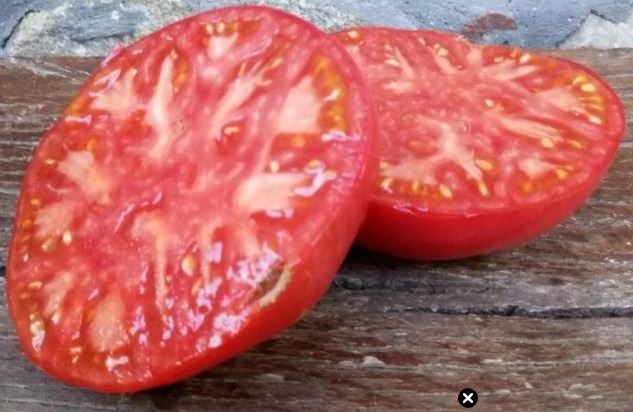
Characterization Descriptors for the "Hawaiian Pineapple" Heirloom Tomato
An exceptionally large bicolour beefsteak, weighing from 500 g to over a kilogram, with golden flesh marbled with crimson red and a sweet, fruity flavour with very low acidity. It is neither Hawaiian nor pineapple-flavoured, but it is one of the most spectacular varieties when sliced.
History and origins
Few varieties pack so many misconceptions into so few words as Hawaiian Pineapple. It does not come from Hawaii, it is not shaped like a pineapple, and any resemblance between its flavour and that fruit is debatable, to say the least. The name is purely commercial: Merlin Gleckler, of the well-known family seed company Gleckler’s Seedmen in Ohio, introduced it to the public under that name in the 1950s. Its true origins point to Kentucky or eastern Ohio, the region where many of North America’s large bicolour beefsteaks were developed.
The confusion does not end there. George Gleckler, Merlin’s son, has suggested that Hawaiian Pineapple may actually be the same variety sold under the names Georgia Streak and Marizol Gold. There is also a documented case of mislabelling: a listing for a supposed “Marianna’s Hawaiian Pineapple” arose from a misreading of the supplier’s name on a seed packet and refers to exactly the same variety. Such mix-ups are commonplace among heritage fruit and vegetable varieties and are part of the identification work undertaken by seed banks.
Its commercial journey continued in the 1970s, when it was grown commercially in southern Indiana, and later with its arrival in Europe, where it became the most widespread member of the “pineapple” tomato family. Today, it lends its name to an entire group of varieties that includes green, dark, heart-shaped and potato-leaved types.
Its offspring are perhaps its greatest endorsement. Hawaiian Pineapple is one of the parents of Ananas Noire (Black Pineapple), the celebrated dark bicolour variety introduced in 2005 by Belgian horticulturist Pascal Moreau, and of Oxheart Pineapple, a cross with Giant Yellow Oxheart. Its colouring comes from the combination of yellow-based flesh and an uneven distribution of lycopene, which creates the radial red marbling inside the fruit that cannot be reproduced in commercial varieties.
Key characteristics
Exceptional size: fruits typically weigh 500–900 g, with some exceeding one kilogram. Bicolour interior: golden flesh with radial red streaks, with a different pattern in every fruit. Very low acidity: a sweet, fruity flavour with a hint of citrus, suitable for those sensitive to acidic flavours. Introduced by Gleckler’s Seedmen in the 1950s; probably originated in Kentucky or eastern Ohio. Parent of Ananas Noire: one of the most celebrated dark bicolour varieties descends from it. Few seeds and plenty of flesh: a single slice covers a plate. Misleading name: neither Hawaiian nor pineapple-shaped; the name was strictly a marketing choice. Late-season variety: 85–95 days from transplanting, with the harvest concentrated in late summer.
Cultural significance
Hawaiian Pineapple is a textbook example of how varieties acquire their names through marketing. In the 1950s, when North American seed companies competed for attention in mail-order catalogues, an exotic name was worth more than an authentic place of origin. That marketing decision has endured for seventy years and is now an inseparable part of the variety’s identity, even though it describes none of its traits.
For those working in conservation, this case is particularly instructive. The likelihood that Hawaiian Pineapple, Georgia Streak and Marizol Gold are the same variety, together with the labelling error that created a fourth, phantom name, illustrates an uncomfortable reality: much of the apparent diversity in catalogues consists of different names for the same genetic material. Distinguishing genuine diversity from diversity in name alone is one of the least visible yet most essential tasks in any variety collection.
Its genetic value has been demonstrated through the most demanding test: its offspring. Its role as a parent of Ananas Noire shows that traditional varieties are not museum pieces, but living breeding material from which new varieties continue to emerge. Conserving them means keeping that possibility alive.
Technical descriptors
Plant descriptors
Characteristic — Assessment
Growth type: Indeterminate
Growth habit: Vigorous, upright, with long internodes
Plant height: Tall (180–240 cm; may grow taller in a greenhouse)
Plant vigour: Very high
Young stem colour: Green
Stem thickness: Thick
Stem pubescence: Present
Leaf type: Regular leaf
Foliage density: Medium
Leaf colour: Medium green
Leaflet shape: Standard
Leaflet margin: Toothed
Inflorescence type: Simple; fasciated flowers (megablooms) are common
Fruits per truss: 2–4 (often 1–2 for the largest fruits)
Fruit descriptors
Characteristic — Assessment
Fruit shape: Flattened (oblate) beefsteak, ribbed and often irregular
Fruit weight: Very large (450–900 g; some fruits exceed 1 kg)
Fruit diameter: Very large (10–15 cm)
Unripe fruit colour: Pale green to whitish, without dark shoulders
Ripe fruit colour: Golden yellow to orange with a pinkish-red blush
Colour uniformity: Low: bicolour, with variable shading and marbling
Green shoulders: Absent
Shoulder shape: Flattened, with a broad, deep stem attachment
Ribbing: Pronounced, particularly around the stem end
Number of sepals: Usually 6–7
Fruit glossiness: Medium to matt
Calyx scar: Broad and recessed, sometimes corky
Skin thickness: Thin and delicate
Number of locules: Multilocular, with a highly irregular arrangement
Wall thickness: Very thick (fleshy, with little gel)
Flesh firmness: Medium; tender and juicy when fully ripe
Flesh colour: Bicolour: golden orange with radial red streaks
Juice content: High (higher water content than a paste tomato)
Seed quantity: Few
Acidity: Very low
Flavour profile: Sweet, fruity and honeyed, with a citrus undertone and tropical notes
Agronomic characteristics
Characteristic — Assessment
Days to flowering: Late (60–70)
Days to harvest: Late (85–95 days from transplanting; up to 100 in cool climates)
Yield per plant: Good (4–6 kg), concentrated towards the end of the growing cycle
Number of fruits per plant: Low to medium (8–15, owing to the large fruit size)
Harvest concentration: Distinctly late: second half of the growing season
Optimum ripening temperature: 20–25 °C; colour development stops above 30 °C
Heat tolerance: Good fruit set in warm conditions; ripening slows in extreme heat
Cold tolerance: Medium to low: ripening is delayed below 13 °C
Support requirements: Essential, with very strong support (fruits weighing up to 1 kg)
Pruning / side-shoot removal: Train to a single stem; pinch out the growing tip after the fourth or fifth truss in cool climates
Recommended spacing: 60–90 cm between plants
Irrigation management: Consistent and regular; fluctuations cause cracking and blossom-end rot
Harvesting: Judge by touch, not colour: the fruit yields slightly to gentle thumb pressure
Post-harvest storage: Very short (thin skin and tender flesh); best consumed immediately
Resistance and tolerance
Characteristic — Assessment
Early blight (Alternaria solani): Medium to low tolerance
Septoria leaf spot (Septoria lycopersici): Susceptible
Anthracnose (Colletotrichum spp.): Susceptible when ripe
Fusarium wilt (Fusarium oxysporum): No documented genetic resistance
Verticillium wilt (Verticillium dahliae): No documented genetic resistance
Late blight (Phytophthora infestans): Susceptible
Powdery mildew (Leveillula taurica): Medium tolerance
Tomato mosaic virus (ToMV): No documented genetic resistance
Blossom-end rot (physiological disorder): High susceptibility owing to the large fruit size
Fruit cracking: Susceptible, particularly following rain after a dry spell
Catfacing (fruit deformity linked to abnormal flower development): High susceptibility, typical of large beefsteaks
Sunscald: Susceptible (medium-density foliage and exposed fruits)
Note: As a traditional open-pollinated variety, Hawaiian Pineapple does not carry formally characterised resistance genes, and its large fruit size makes it inherently vulnerable to physiological fruit disorders. These assessments are based on field observations and vary according to climate, soil and growing practices. Under Atlantic climate conditions, its main limitation is not disease but temperature: it is a late-season variety that needs accumulated warmth to ripen fully, making protected cultivation highly advisable north of the Cantabrian Mountains.
Growing tips
Start seeds early: As a late-season variety, it is best sown 6–8 weeks before transplanting to ensure a harvest before autumn.
Protected cultivation in Atlantic climates: Use a greenhouse or polytunnel to provide the accumulated warmth needed for ripening.
Pinch out the growing tip: Do this after the fourth or fifth truss under cover, or the third outdoors, to direct growth into fruit size and encourage earlier ripening.
Heavy-duty support: Fruits can exceed one kilogram; support individual trusses with slings or soft ties.
Keep watering consistent: An even water supply is the best prevention against cracking and blossom-end rot.
Harvest by touch: The fruit never turns fully red; it is ready when it yields slightly to gentle pressure, not before.
Recommended uses
Raw, sliced: Its natural use; a single slice covers a plate and reveals the full marbling.
Tastings and displays: The contrasting colours revealed when sliced make it the centrepiece of any tomato variety display.
Salads and sandwiches: Fleshy, with few seeds and no harsh acidity.
Colourful gazpachos and salmorejos: Adds unusual golden tones and natural sweetness.
Sauces and soups: Requires longer cooking than a paste tomato because of its higher water content.
Dehydrating: Significantly concentrates its fruity notes.
Creative cuisine: Highly valued for its low acidity and striking appearance.
Home-canning warning: Because of its very low acidity, this variety is not suitable for home water-bath canning without prior acidification. Use a tested tomato-canning recipe from a recognised food-preservation authority, following its specified acidification quantities and processing times; a pH reading alone does not establish a safe canning process.
www.simientesinfinitas.com IG @simientes_infinitas
Origin: A North American heirloom variety probably originating in Kentucky or eastern Ohio, commercially introduced under the name Hawaiian Pineapple by Merlin Gleckler (Gleckler’s Seedmen) in the 1950s, with no connection to the Hawaiian Islands. Possibly identical to Georgia Streak and Marizol Gold. Grown commercially in southern Indiana in the 1970s and later introduced to Europe. One of the parents of Ananas Noire (Pascal Moreau, 2005) and Oxheart Pineapple.
A variety maintained and propagated by Asociación Simientes Infinitas, which conserves a collection of 1,700 heirloom tomato varieties to prevent genetic erosion.