Characterization Descriptors of the "Boondocks" Heirloom Tomato
Simientes Infinitas Association
We safeguard, preserve, and reproduce a collection of 1,700 heirloom tomato varieties. We work to prevent genetic erosion.
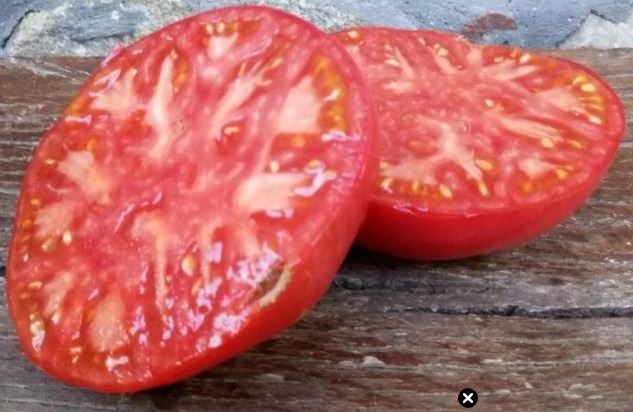
A large-calibre pink beefsteak with potato-like leaves, which came to the seed guardian network through the enigmatic Joe Bratka of New Jersey. Flattened fruits weighing 250–450 g (occasionally close to a kilogram), with juicy flesh and a rich, balanced flavor that is both sweet and tart, reminiscent of the tomatoes "of yesteryear."
History and origin
Boondocks is part of a small group of American varieties that share the same origin: Joe Bratka, a horticulturist from Elmwood Park, New Jersey, whom Craig LeHoullier himself refers to as "the mysterious Joe Bratka." Eva Purple Ball and Marizol Gold also come from the Bratka family, which, according to family tradition, arrived in the United States from Germany's Black Forest at the end of the 19th century, and Red Barn, developed by Joe's father and recovered from seeds stored in glass jars in a shed on the farm.
Boondocks' documented history begins in the early 1990s, when Joe Bratka gave the seeds to Dr. Carolyn J. Male of Latham, New York, one of the leading collectors of heirloom tomatoes of her generation and author of 100 Heirloom Tomatoes for the American Garden. Carolyn Male offered it at the Seed Savers Exchange in 1994, and from there it made its way into catalogs such as Tomato Growers Supply, TomatoFest, Reimer Seeds, and Tatiana's TOMATObase. Through this New York route, many sellers now present it as a "New York heirloom," although its original guardian lived in New Jersey.
What is not documented is its true age or the reason for its name. Some European sources attribute it to a selection made by Bratka himself in the 1990s, while most seed banks classify it as a family heirloom. There is also no record of the Appalachian origin or the subsistence farmers sometimes attributed to it; it is a legend unsupported by documentation that we prefer not to repeat. It also circulates under the spellings Boondocs and Bled.
Cultural significance
The name comes from boondocks, an American English colloquial term for remote places, "where Christ lost his lighter." The word derives from the Tagalog bundok (mountain), and it was brought to the United States by soldiers stationed in the Philippines at the beginning of the 20th century. Who named the tomato this way, and why, remains a mystery.
Its value as heritage is precisely that of the informal exchange network that saved it: a seed passed from hand to hand among enthusiasts, without commercial backing, which today survives thanks to seed guardians. This is the same work done by the Simientes Infinitas Association with its collection.
Outstanding characteristics
-
Documented origin: seed from Joe Bratka (New Jersey), given to Carolyn J. Male, who introduced it to the Seed Savers Exchange in 1994
-
Bratka variety family: related by origin to Eva Purple Ball, Marizol Gold, and Red Barn
-
Potato-like leaves: broad and lush foliage, highly decorative and protective of the fruit
-
Large-calibre pink beefsteak: fruits weighing 250–450 g, with specimens approaching a kilogram
-
Balanced flavor: rich in both sugars and tartness, with a classic profile; often compared to Brandywine
-
High and consistent productivity: stands out for its yield within its fruit type
-
Mid-season: about 80 days from transplanting
Technical descriptors
Plant descriptors
| Characteristic |
Evaluation |
| Growth type |
Indeterminate |
| Growth habit |
Lush and vigorous, with an open habit |
| Plant height |
Tall (150–200 cm; taller in a greenhouse) |
| Plant vigor |
High |
| Young stem color |
Green |
| Stem thickness |
Thick |
| Stem pubescence |
Present |
| Leaf type |
Potato-like leaf (entire leaflets, not serrated) |
| Foliage density |
High |
| Leaf color |
Medium to dark green |
| Leaflet shape |
Wide, oval, with smooth edges |
| Inflorescence type |
Simple to branched; frequent fasciated flowers (up to 9 sepals) |
| Fruits per cluster |
3–6 set (clusters of up to 6–9 flowers) |
Fruit descriptors
| Characteristic |
Evaluation |
| Fruit shape |
Flattened (oblate), beefsteak type; slightly flattened at the poles |
| Fruit weight |
Large (250–450 g; specimens of 700–900 g) |
| Fruit diameter |
Large (9–13 cm) |
| Immature fruit color |
Light green, with a slightly darker shoulder |
| Mature fruit color |
Intense pink to pink-purple (colorless skin over red pulp) |
| Color intensity |
High |
| Presence of green shoulders |
Absent or weak at full maturity |
| Surface smoothness |
Smooth on medium fruits; ribbed in the peduncular area on large fruits |
| Presence of ribs |
Weak to medium (increases with calibre) |
| Fruit shine |
Medium |
| Calyx scar |
Wide, depressed, and corky |
| Pistil scar |
Medium to large, sometimes irregular on fasciated fruits |
| Skin thickness |
Thin |
| Number of locules |
Multilocular (6–10), irregular distribution |
| Wall thickness |
Medium to thick |
| Pulp firmness |
Medium; fleshy, smooth, and juicy |
| Pulp color |
Intense pink-red |
| Juice content |
High |
| Seed count |
Medium-low |
| Organoleptic profile |
Rich and balanced, with high sugars and tartness; classic heirloom tomato flavor |
Agronomic characteristics
| Characteristic |
Evaluation |
| Days to flowering |
Mid-season (55–65) |
| Days to harvest |
Mid-season (about 80 days from transplanting) |
| Yield per plant |
High for its calibre (4–7 kg) |
| Number of fruits per plant |
Medium (15–30) |
| Harvest concentration |
Staggered and regular until autumn |
| Heat tolerance |
Medium (fruit set decreases with high nighttime temperatures) |
| Cold tolerance |
Medium |
| Adaptation to low light |
Medium-good |
| Need for support |
Essential and reinforced (fruit and foliage weight) |
| Pruning / thinning |
Recommended to 1–2 stems to gain calibre and ventilation |
| Recommended spacing |
60–80 cm between plants |
| Irrigation management |
Regular and without excess after fruit set; sudden changes favor cracking |
| Post-harvest storage |
Short (thin skin); preferably consumed fresh and locally |
Resistances and tolerances
| Characteristic |
Evaluation |
| Alternaria (Alternaria solani) |
Medium tolerance |
| Fusarium (Fusarium oxysporum) |
No documented genetic resistance |
| Verticillium (Verticillium dahliae) |
No documented genetic resistance |
| Late blight (Phytophthora infestans) |
Susceptible (like most traditional varieties) |
| Powdery mildew (Leveillula taurica) |
Medium tolerance |
| Botrytis (Botrytis cinerea) |
Susceptible in humid and poorly ventilated environments |
| Tomato mosaic virus (ToMV) |
No documented genetic resistance |
| Yellow leaf curl virus (TYLCV) |
No documented genetic resistance |
| Blossom end rot (physiological disorder) |
Medium susceptibility; requires calcium and regular irrigation |
| Cracking (cracking) |
Susceptible (marked tendency in large fruits) |
| Sunscald |
Resistant (the potato-like foliage protects the fruit) |
| Heat stress during flowering |
Medium tolerance |
Note: as befits a traditional open-pollinated variety, Boondocks does not carry formally characterized resistance genes. The ratings in this table come from accumulated field observations by growers and seed banks, and may vary depending on climate, soil, and management. In Atlantic conditions with humid summers, its susceptibility to cracking and Phytophthora pressure makes localized and regular irrigation, thinning of lower leaves, and preventive copper or horsetail tea treatments especially advisable.
Cultivation tips
-
Solid support from the beginning: the combination of lush foliage and half-kilogram fruits defeats light supports
-
Constant irrigation: avoid alternating drought and abundant irrigation, the main cause of cracking in this variety
-
Pruning to one or two stems: improves calibre, ventilation, and reduces fungal pressure
-
Cluster thinning: leave 3–4 fruits per cluster if maximum calibre is desired; removing highly fasciated flowers produces more regular fruits
-
Harvest at advanced breaker: picking when the pink covers almost the entire fruit and finishing ripening at home avoids cracks after rains
-
Seed selection: the potato-like leaf allows for the detection of possible crosses (normal-leaf plants) with the naked eye when reproducing it
Recommended uses
-
Fresh consumption: quintessential table tomato, in thick slices with salt and oil
-
Sandwiches and burgers: a single slice covers the bread; juicy and smooth flesh
-
Salads: provides a pink color and a balanced flavor that does not need strong dressings
-
Variety tastings: good example of the classic pink beefsteak, to compare with Brandywine and other pinks
-
Sauces and crushed tomatoes: yields well due to its juiciness and its balance of sweetness and tartness
-
Direct sales and local markets: very striking due to its size, although its thin skin discourages long transport
Origin: open-pollinated variety originating from the United States, preserved by Joe Bratka (Elmwood Park, New Jersey) and given to Carolyn J. Male (Latham, New York) in the early 1990s, who introduced it to the Seed Savers Exchange in 1994. Its exact age and the origin of its name are not documented.
Variety safeguarded and reproduced by the Simientes Infinitas Association, which preserves a collection of 1,700 heirloom tomato varieties to prevent genetic erosion.