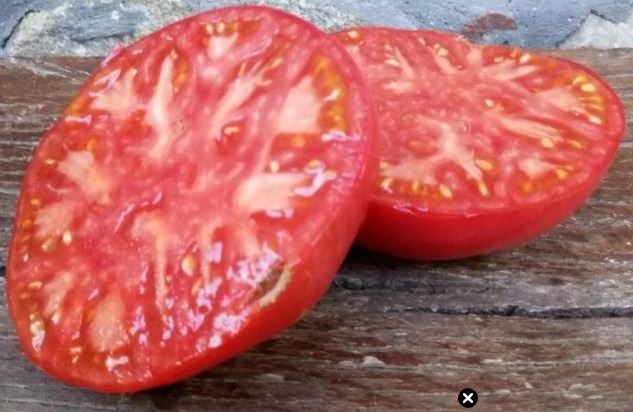
One of the most respected black-fruited varieties in the world: a large-calibre Ukrainian family heirloom with thin skin and a smoky flavour with a saline finish. Flattened fruits weighing 200–400 g, dark mahogany in colour with persistent green shoulders.
History and origin
Black from Tula carries one of the most curious paradoxes in the world of traditional varieties. Although it is universally known as a Tula tomato—Tula being an old industrial and armaments city located about 190 km south of Moscow, famous for its samovars—the most authoritative varietal research places its true origin in Ukraine, where it was preserved as a family heirloom for generations. In her seminal work 100 Heirloom Tomatoes for the American Garden (1999), Dr Carolyn J. Male explicitly documents it as a Ukrainian variety, and even today there is no firm explanation as to why it ended up bearing the name of a Russian city.
Its introduction to the international conservation circuit has a date and a protagonist. Marina Danilenko, a Moscow-based seed grower who, together with her mother, founded Russia's first private seed company after the dissolution of the Soviet Union, sent a collection of traditional Eastern European varieties to the Seed Savers Exchange in 1996. Black from Tula appeared in the 1996 Yearbook under accession code TOMATO 2911, and in 1998 the Seed Savers Exchange itself offered it commercially for the first time as part of its "Russian Collection", alongside other now-legendary varieties such as Paul Robeson and Orange Banana.
Its dark colour does not come from anthocyanins, as is sometimes assumed, but from the coexistence in the pulp of the usual red tomato pigments with chlorophyll retained during ripening. Hence the chocolate-mahogany hue, the dark green shoulders that persist even at full maturity, and the green locular gel that identifies it when cut.
Key characteristics
-
Documented introduction: Seed Savers Exchange Yearbook 1996 (accession TOMATO 2911), via Marina Danilenko
-
Ukrainian origin, Russian name: a Ukrainian family heirloom named after the Russian city of Tula
-
The largest of the "blacks": one of the largest available dark-fruited varieties
-
Complex flavour: sweet, deep and smoky, with a very distinctive saline and earthy finish
-
Heat set: unlike most black tomatoes, it continues to set fruit during heatwaves
-
Protective foliage: very dense regular foliage that prevents sunscald on the fruit
-
Highly resistant to cracking: despite the size and thin skin of the fruit
-
Bibliographic recognition: included in the 100 varieties selected by Carolyn J. Male
Technical descriptors
Plant descriptors
| Characteristic |
Evaluation |
| Growth type |
Indeterminate |
| Growth habit |
Vigorous, robust and very leafy |
| Plant height |
Medium-tall (150–200 cm; up to 220 cm in a greenhouse) |
| Plant vigour |
High |
| Young stem colour |
Green |
| Stem thickness |
Thick, rigid |
| Stem pubescence |
Present |
| Leaf type |
Regular (normal leaf) |
| Foliage density |
Very high |
| Leaf colour |
Dark green |
| Leaflet shape |
Standard, broad |
| Leaflet margin |
Serrated |
| Inflorescence type |
Simple to branched; occasional fasciated flowers |
| Fruits per cluster |
3–6 |
Fruit descriptors
| Characteristic |
Evaluation |
| Fruit shape |
Flattened (oblate), beefsteak type; occasionally irregular |
| Fruit weight |
Large (200–400 g; average 250–350 g) |
| Fruit diameter |
Large (8–13 cm) |
| Unripe fruit colour |
Green with a distinct dark green shoulder |
| Ripe fruit colour |
Dark mahogany to chocolate-brown with purple highlights |
| Colour intensity |
Very intense (increases with direct sunlight) |
| Presence of green shoulders |
Present and persistent (dark green) |
| Surface smoothness |
Smooth, with slight ribbing in the peduncular area |
| Presence of ribs |
Weak to medium (depending on calibre) |
| Fruit shine |
Medium, satin-matte |
| Calyx scar |
Medium, slightly depressed and corky |
| Skin thickness |
Thin |
| Number of locules |
Multilocular (4–8), irregular distribution |
| Wall thickness |
Thick (8–12 mm) |
| Pulp firmness |
Medium, fleshy and dense |
| Pulp colour |
Very dark garnet red |
| Locular gel colour |
Dark green (diagnostic feature of the variety) |
| Juice content |
Medium-high |
| Seed count |
Medium |
| Organoleptic profile |
Sweet and deep, smoky, with a saline-earthy finish and balanced acidity |
Agronomic characteristics
| Characteristic |
Evaluation |
| Days to flowering |
Mid-season (55–65) |
| Days to harvest |
Mid-season (75–85 days from transplanting; up to 87 in cool weather) |
| Yield per plant |
Good (4–7 kg) |
| Number of fruits per plant |
Medium (20–35) |
| Harvest concentration |
Staggered, with two peaks: start of season and late summer-autumn |
| Heat tolerance |
Excellent (maintains fruit set during heatwaves) |
| Cold tolerance |
Good (continental origin with short summers) |
| Adaptation to low light |
Good; colour intensifies in direct sunlight |
| Need for staking |
Essential and reinforced (fruit and foliage weight) |
| Pruning / thinning |
Recommended; thin foliage to promote aeration |
| Recommended spacing |
70–90 cm between plants |
| Irrigation management |
Moderate and regular; reducing inputs after fruit set concentrates the flavour |
| Post-harvest storage |
Short (thin skin); preferably consumed fresh and locally |
Resistances and tolerances
| Characteristic |
Evaluation |
| Alternaria (Alternaria solani) |
Medium tolerance |
| Fusarium (Fusarium oxysporum) |
Medium-low tolerance |
| Verticillium (Verticillium dahliae) |
Medium tolerance |
| Mildew (Phytophthora infestans) |
Susceptible (aggravated by foliage density) |
| Oidium (Leveillula taurica) |
Medium tolerance |
| Botrytis (Botrytis cinerea) |
Susceptible in humid and poorly ventilated environments |
| Tomato mosaic virus (ToMV) |
No documented genetic resistance |
| Tomato yellow leaf curl virus (TYLCV) |
No documented genetic resistance |
| Blossom-end rot (physiological disorder) |
Medium-high susceptibility; requires calcium and regular irrigation |
| Cracking (cracking) |
Highly resistant |
| Sunscald |
Highly resistant (dense foliage protects the fruit) |
| Heat stress during flowering |
Highly tolerant |
Note: as is typical of an open-pollinated traditional variety, Black from Tula does not carry formally characterised resistance genes. The ratings in this table are based on cumulative field observations by growers and seed banks, and may vary depending on climate, soil, and management. In Atlantic conditions with wet summers, the combination of very dense foliage and Phytophthora pressure makes wide plant spacing, thinning lower leaves, drip irrigation, and preventive copper or horsetail tea treatments particularly advisable.
Cultivation tips
-
Wide plant spacing: 70–90 cm between plants, wider than usual, to compensate for foliage density and promote ventilation
-
Reinforced staking: the combined weight of the fruit and plant requires sturdy structures
-
Restricted irrigation after fruit set: moderately reducing inputs notably concentrates the smoky profile
-
Regular calcium supply: large-calibre fruits are susceptible to blossom-end rot if irrigation is irregular
-
Harvest at the right time: the green shoulder does not indicate immaturity; the fruit is ready when it gives slightly under pressure
Recommended uses
-
Fresh consumption: an outstanding table variety, sliced thickly with salt and good oil
-
Tastings and varietal days: essential for its colour contrast and aromatic complexity
-
Salads and sandwiches: a classic use in its area of origin; its dense pulp holds up well to cutting
-
Roasting and grilling: heat concentrates its sweet and smoky notes
-
Gourmet sauces and preserves: it provides an unusually dark colour and depth of flavour
-
Direct sales and local markets: highly sought after for its uniqueness, although its thin skin makes long-distance transport inadvisable
Origin: a Ukrainian family heirloom variety, introduced internationally under the name of the Russian city of Tula. Introduced to the West in 1996 by seed grower Marina Danilenko via the Seed Savers Exchange (accession TOMATO 2911) and first marketed in 1998 as part of the "Russian Collection". Documented by Carolyn J. Male in 100 Heirloom Tomatoes for the American Garden and by Amy Goldman in The Heirloom Tomato.
A variety conserved and propagated by the Simientes Infinitas Association, which maintains a collection of 1,700 heirloom tomato varieties to prevent genetic erosion.